Phish is a band that has never looked backwards. The Vermont quartet has eschewed nostalgia for forward motion for the entirety of their forty-plus year career. Thus, when rumors emerged of a run of throwback shows at Madison Square Garden celebrating the years of the mid-‘90s, it felt…strange. Though many bands of their age spend their modern tours looking back at the heydays of their careers by playing songs that were popular decades ago, Phish has consistently churned out new music and made their mark by pushing forward despite their well-loved legacy.
Employing set lists typical of their formative years, the first three nights of their nostalgic jaunt contained some notable highlights, though were delivered with varying degrees of success. Their 1993 show popped considerably more than ’92 or ’94, but the entire concept felt a bit contrived. This was not how Phish did business. Thus, when the band took the stage to reflect on their hallmark year of 1995, they were amidst a decidedly un-Phishy spectacle. But once this night had transpired—whether intentionally or unintentionally (I maintain the latter)—Phish had discovered a new and innovative course for their immediate future.
Architects of Evolution
Throughout their initial phase of existence, specifically during the time periods of 1993-1995 and Halloween ’96-Japan 00, Phish was a constantly evolving musical force. Their improvisational style developed methodically, with a through line connecting their music in both of these multi-year eras. Each night, each tour, each year built on what had come before, as the band added elements to their musical style while paring away others. A large part of the excitement of following the band—whether in person or on tape—was the adventure of where this evolutionary process would take them.
Phish started to regularly improvise, in earnest, in the Summer of 1993. During this year, their frenetic, telekinetic jamming pushed song structures to their breaking points and beyond, as the band began to dabble in open-ended (type II) jams. This tightly wound, breakneck style that defined Summer ’93 was rooted in the amalgamation of the prog-rock and jazz paradigms, though come Spring 1994, that style could be pushed no further, and they began to infuse a psych twist into their jams, loosening up just a bit and adding a dash more exploration. This trend expanded over Summer, but rightfully exploded in Fall ’94, a tour which saw the band embrace long-form jamming with a far looser, exploratory style. Phish jams ballooned in length and depth, as the band embarked on their most ambitious improvisational journeys to date. Come Summer ’95, the band pushed even further into the abstract, with amorphous psychedelic adventures far deeper than any spaces they had yet plunged. Fall ’95 saw things tighten up a bit as they fully realized their transformation into a full-blown arena act who gleaned from all of these previous styles while crafting blistering, high speed jams that didn’t shy from the spirit of discovery. This evolutionary arc peaked at Madison Square Garden in the final two shows of the year, including their first ever Big Apple New Year’s Eve bash, in what many saw as their most significant and accomplished performance to date.
Phish’s second evolutionary arc of the ‘90s was sparked by their Halloween show of 1996, in which they covered the Talking Head’s masterpiece, “Remain in Light.” Their study and performance of the album’s percussive grooves set them on a rhythmic based transformation that would evolve throughout the next several years. This style fully clicked in a small German club in Hamburg in March of 1997, catalyzing the “cow funk” revolution that took Summer ’97 by storm. Diving head first into thick, slow, raw funk jams, the band pivoted into something completely other than anything that had come before. This style became more refined over the band’s legendary fall tour in which Phish’s “funk” became a living and breathing entity. They rode this wave through Summer ’98, morphing into a style a bit chunkier and rounder than the grooves of Fall ’97, but the band truly took its next step on the final night of Lemonwheel in a transcendent and amorphous “ambient” excursion in “Ghost.” It was this amorphous-ambient style of improvisation that they expounded on come Fall Tour, with some of the most profoundly abstract and mind-expanding music they had ever unveiled. 1999 saw them progress into more hypnotic jamming through the use of layering, repetition, and drone, developing a style of Phish trance that built from the grooves of the previous two years. This evolutionary arc peaked with the millennial concerts at Big Cypress and their Summer 2000 Japan tour that contained some of their most creative playing of all-time.
The evolutionary paths that defined these two eras contained traceable through lines with which one could follow a clear progression and development of their styles. Phish 2.0 certainly had a signature sound, but didn’t last long enough to truly evolve. Throughout the majority of Phish’s 3.0 era, and specifically in their post-pandemic chapter, however, this sort of musical evolution has been missing. The band’s improvisational approach has been more of a stylistic grab bag on any given night. On their best nights, Phish still crafts stunningly creative music, often hinting at motifs from their past, but when things don’t fully click, their improvisation tends to gravitate towards a more homogenous place that blends together and doesn’t stand out as particularly unique. Though anything is possible on any given night—such is the nature of Phish—the limitless potentialities that once imbued Phish shows had felt a bit muted in recent years. The pre-MSG shows of Summer ’26 began to buck this trend, as the band began to expand older songs that had never been jammed with a renewed creative approach, so when they arrived at the Garden and began to play pre-mediated shows, the shift felt somewhat non-congruent. It is within this context that they arrived at the now pivotal performance of July 27, the return to 1995.
July 27, 2026
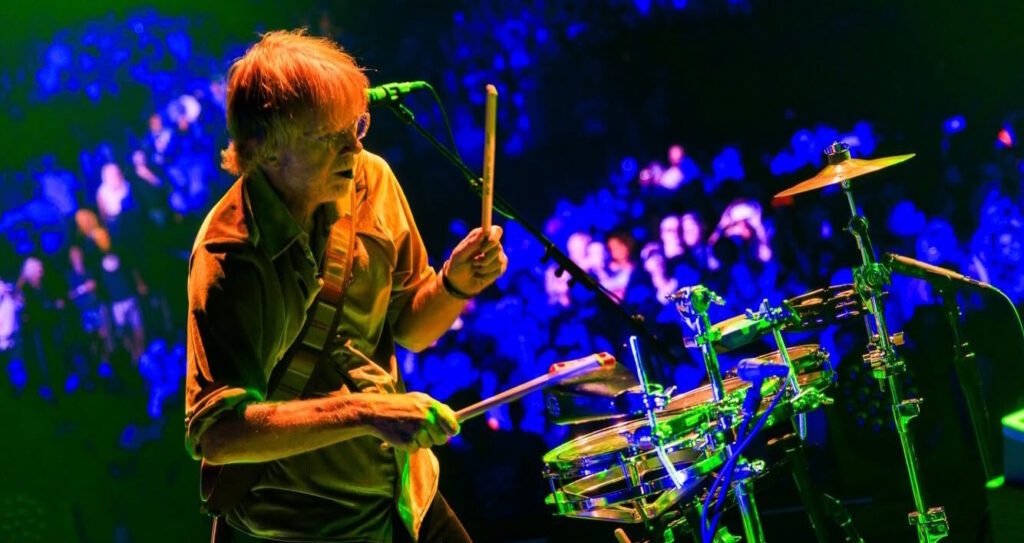
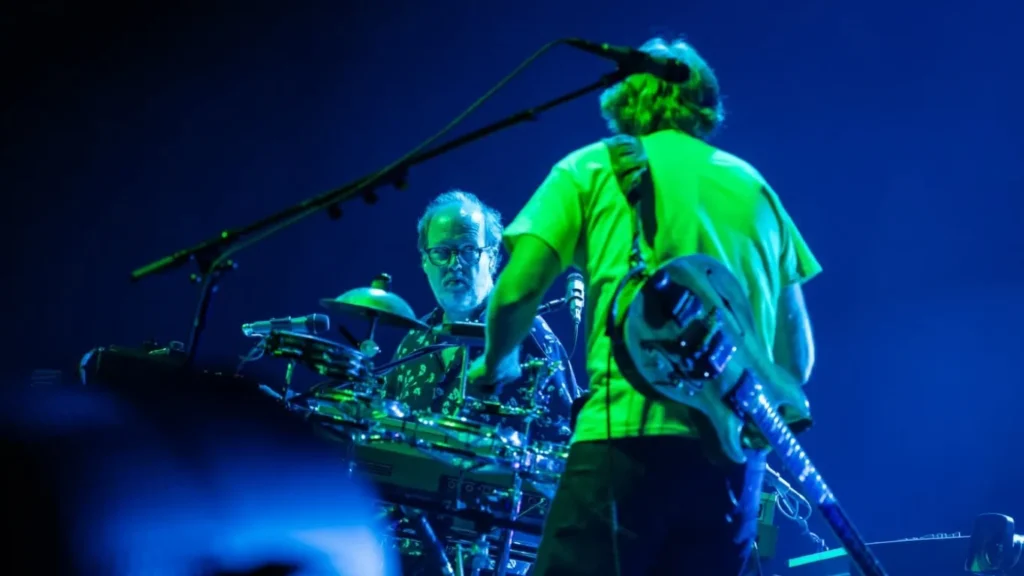
Pivot points in Phish music can transpire when you least expect them, and when this show started, few, if any, people foresaw what was in store. When the band dropped into the jams of the early-set “Timber Ho!” and the late-set “Halley’s Comet,” Trey promptly got off of his guitar and hopped on a mini percussion kit, hearkening back to Fall ’95, when he prominently featured this setup amidst many of their improvisations. But this time, the resulting music sounded quite different. Unlike 31 years ago, Mike and Page were now armed with a modern sonic arsenal capable of filling the guitar-less music with leads and diverse sounds that pushed the jams in innovative directions. With the lack of a lead guitar anchor in the music, Mike synth-bass effects and Page’s synthesizer leads allowed the music to expand and breathe in a completely new fashion, favoring rhythmic interplay and fomenting a sort of Phishtronica unlike anything the band had played before.
At set break, I was drooling over these jams. For the previous year or so, I had been saying that Phish needed a shot in the arm, something to break the rut of similar, generic jamming in which they so often found themselves. Without the stylistic foci of yesteryear, and without an evolutionary arc that characterized their most prolific eras, the band often got stuck in rote improvisational patterns that lacked originality and creativity. It did not happen all the time, but it certainly happened a lot, especially within the longer jams they had been rolling out during 2025. But this “Halley’s” jam that had just transpir