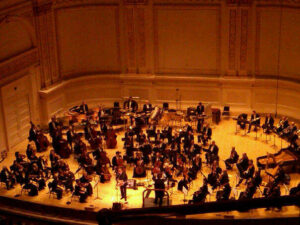
Download and Listen: 9.12.09 Carnegie Hall “YEM” < link Unreal. (thanks Mitch!) 9.12.09 – Carnegie Hall (Photo: Pete Mason) Trey and the New York Philharmonic Orchestra < Whole show download I. First Tube, Inlaw Josie Wales, Brian and Robert, Divided Sky, Water in the Sky, Pebbles and Marbles, Guyute II. Time Turns Elastic, Let Me …
One of the most endearing moments of June’s tour was Bruce Springsteen’s guest spot at Bonnaroo. Rumors swirled about Phish and The Boss taking the stage together, and with Trey’s known admiration of Bruce, a collaboration seemed likely. Throughout our Phish lives, we have heard stories of Trey, growing up in New Jersey, looking up to the state’s most famous son as the epitome a rock star. Now, as headliners of the same festival, the stage was set.
6.14 (J.Kravitz)
A legend of Americana’s singer-songwriter tradition, Springsteen’s music spoke to a generation of youth, longing for freedom and adventure in the 1970s, a decade focused on reestablishing cultural stability in America. His songs carried the voice of “everyman,” making his music emotionally universal. Trey, as well as many of us, grew up listening to Bruce’s raspy folktales over his poignant hooks and melodies. From “Greetings From Asbury Park” and “The Wild, The Innocent & the E Street Shuffle” to “Born to Run,” and “Born In the USA,” the Boss brought many of us through our youth, dreaming about “get[ing] out while we [we]re young.” And when we finally did get out, look what we found. Maybe this wasn’t the scenario for everyone, but there is no doubt that Bruce Springsteen is an American rock and roll icon.
“Mustang Sally” (D.Gunnells)
After Phish had just completed a intense run through “Tweezer > Horse > Silent, Antelope,” it seemed that Bonnaroo’s first set was over, but as Trey stepped to the mic he began to tell us a story. Reminiscing on the first concert he ever attended, Bruce Springsteen in Princeton, NJ, he explained how blown away he was by the intensity and energy in the room that night. In a past interview, Trey said he had never witnessed someone command the attention of an entire room like Jerry Garcia or Bruce Springsteen. Now, sharing the stage with the legend, he welcomed his “boyhood hero” to the stage. His shit-eating grin told the rest of his story for him. (Side note: Trey previously told us, on 12.15.95, that his first concert was Jethro Tull at The Spectrum. Hmm.)
Trey’s Introduction ———————
“Mustang Sally” (D.Gunnells)
Just as we have heroes, so does Trey- and watching his dream come true was awesome. The band started with “Mustang Sally,” a straight forward rocker in order to get acclimated to each other’s chops and to loosen up without any technical playing. Having a grand time on stage, Trey and Bruce traded licks over a steady groove. But when the standard ended, Bruce looked over at Trey and Phish, saying- “Alright, we’re gonna try this one,” as they started “Bobby Jean”- a dark-horse track from “Born in the USA.” Interestingly enough, this song was considered a musical breakthrough for Springsteen upon its recording, with a more accented rhythm and danceable groove- a perfect selection. As the band moved through the anecdotal song, it was very sublime to hear Trey’s guitar back Bruce’s composition in some stylistic Jersey-fusion.
But the highest moment of their three-song performance was unquestionably “Glory Days.” Taking a song that everyone in the massive crowd connected to in one way or another, Phish and Bruce tore through the ’80s hit more than proficiently. And one of the best moments of the weekend came when Bruce turned the reigns over to Trey during the solo. Taking liberty, Trey threw down a monster solo with many of his signature licks; like a kid in a candy store, he shredded the classic. There was also something overtly powerful as the two aging guitarists wailed together on the nostalgic “Glory Days;” certainly a moment. Climaxing the song, the band and Bruce moved into the final verse and on into setbreak.
Much of the crowd buzzed during the break about the superstar-sit in, and many were overheard saying, “Best Glory Days EVER!” As Phish prepared to come out for Bonnaroo’s final set, Trey had already lived a dream. Sober, happy, and playing on the nation’s biggest summer stage with one of his heroes, his look said it all. As they say, a picture is worth a thousand words, and in this case, maybe more.
This is one of the most well-loved two-setters on Europe’s Summer ’96 tour. Sprinkled between their opening sets for Santana, Phish played a series of headlining gigs, and none more on point than this night in Germany. With a great setlist and tight playing, Nuremberg was a keeper.
I: Golgi Apparatus, Guelah Papyrus, Rift, Tweezer, If I Could, My Mind’s Got a Mind of It’s Own, Split Open and Melt, The Horse > Silent in the Morning, Taste, Train Song*, Fee > Timber (Jerry), Johnny B. Goode
II: Llama, Theme From the Bottom, Reba, Life on Mars, Free, Run Like an Antelope, Simple, Prince Caspian, Suzy Greenberg
E: Harry Hood
*First time played.
Source: unknown
One of the most endearing moments of June’s tour was Bruce Springsteen’s guest spot at Bonnaroo. Rumors swirled about Phish and The Boss taking the stage together, and with Trey’s known admiration of Bruce, a collaboration seemed likely. Throughout our Phish lives, we have heard stories of Trey, growing up in New Jersey, looking up …
As we approach our final stages of preparation for Phish 3.0, many readers have put out the practical request to review some of the new music we could hear from Trey’s new catalog come Hampton and beyond. On his Classic TAB tour last October, he played many new songs that he and Tom Marshall had recently finished; and something tells me Trey and Tom didn’t sit down to write a bunch of tunes for Tony, Russ, and Ray to play! If things are as they appear, Trey wrote most of this new material with Phish in mind.
Having played some of his new songs once, and others only a few times over his eight shows, it seemed that Trey was holding out on the most significant songs, waiting for his “other” band to chart their destinies.
Obviously, any TAB versions of these songs represent mere templates of what they could be. What Phish will do with these pieces if, and when, they play them is a whole different story. Here are ten selections we may hear come 3.0.
Backwards Down the Number Line
Debuted acoustically at Rothbury last summer, and played over the second half of Trey’s tour, this is the new song that all fans are familiar with. The song’s poignant theme of old friends reuniting captures the tone of the moment in the Phish world. With an uptempo rock-based jam and a lyrical reprise at the end, this song seems like the new-school “Down With Disease.” Odds are favorable that we will hear this at Hampton, potentially opening one of the three second sets.
Light
“Light” is the song that *sounds* like Phish the most. With sublime harmonies and melodies within a transcendent milieu for improvisation, this song seems specifically written for our favorite foursome. With an ambient intro, reflective lyrics, and a soaring jam, this one brings shivers just imagining what Phish could do with it. Trey only played this song once over his tour, most likely signaling its place in the Phish universe. When they bust this one out, you will know- it will be one of the highlights of the show. “Tweezer > Light,” anyone?
Greyhound Rising
A multi-faceted compositional beast, “Greyhound Rising” is another song that seems custom made for Phish. Beginning with a gorgeous ballad-esque feel, the song progresses through wistful lyrical passages before moving into the distinctly different, and more grooving, second section. The song then slides into a blues-based jam before eventually building back to the original lyrical melodies. “Greyhound Rising” has a little of everything Phishy, and it is another that sounds like a perfect fit for the band.
Valentine
This song was only brought out twice along Trey’s tour due to the improvisational limitations of TAB. When this song first dropped in Brooklyn last summer, it was an immediate favorite with its soulful feel and unique lyrical path. An inspiring piece of music, this one seemed to be stashed away for Phish after TAB’s third show; a guitar solo could only take it so far. Add Mike, Page, and Fish to this tune, and you’ve got a Phish staple for years to come. This song catches you immediately and draws you right into its flow. This will fit in perfectly if Phish so chooses.
A Case of Ice and Snow
Trey included an acoustic version of this song on his solo album,Bar 17, but when he played it throughout his solo tour, the song took on a wholly different shape. Reflecting on hard times gone by, the mellow and gorgeous song could give way to surreal soundscapes, something that was merely hinted at via TAB. Again, this sounds very much like a Phish song, and it could be a tremendous addition deep in the second set- like how The Dead used “Morning Dew.”
Ruby Waves
Trey only busted this song out once over his eight shows. Representing the poppier side of his writing, this song could certainly fit in with Phish 3.0. Boasting a smooth palatable groove and an uplifting chorus, this could turn out to be a latter-day Phish “single” with legitimate improvisational potential when played live. This is a song that Phish could vibrantly enhance.
Burlap Sack & Pumps
Consistently introduced with the group of songs that Trey wrote with Tony and Russ, and that made the transition to Phish, it seemed that Trey was implying that this song would do the same. A centerpiece of Trey’s October tour, this was rearranged for a four-piece, with Trey taking adopting the horn’s lead melodies from TAB’s big-band incarnation. With two distinct jams, this “Burlap Sack & Pumps” could provide multiple launch pads for Phish. Many feel that due to the song’s long TAB history, this one won’t be brought into Phish. Yet, after hearing the psychedelic planes that this song traversed throughout Trey’s tour, I wouldn’t be making any wagers!
Let Me Lie
This could be the next beautiful Phish ballad, though due to its incredibly autobiographical nature, I’m not sure it will make the jump. Played extensively over TAB tour, this recovery-themed song seemed very appropriate for his solo comeback performances. Though the song would definitely translate beautifully to Phish, whether they choose to include it is another story.
Spin
An older song off of Shine, this was also played a on GRAB tour a few years ago, so Mike already knows it. Played twice over the recent TAB tour, “Spin” possesses an dark and open-ended ambient jam at the end that Phish could absolutely slaughter. A reflection on Trey’s less-happy days, this one could also be too personal to bring to his “other” band. If Phish does decide to play this- forget about it- the results will be huge.
Alaska
A straightforward, and somewhat comedic, blues song, Phish could adopt this for a diversity of feels. This could work, bringing some dirty blues-based jamming into the mix. As most fans seem to know the lyrics already, this one could be an underwhelming arena sing-along that morphs into improv. Only time will tell.
The second movement of Trey’s orchestral piece that he debuted with Orchestra Nashville in September surfaced as a solo acoustic demo on the Internet. When listening to the acoustic piece, one can hear how this entire movement could translate into a latter day Phish epic. With lyrics rich in imagery and diverse musical approaches, this “song” could develop into a masterpiece.
ANDY GADIEL ON THE RADIO / WEB STREAM TONIGHT! – 8-10 pm
Godfather of Phish Internet space, and good friend, Andy Gadiel, will be guest DJing a special “Phish Reunion Set” set tonight on KPFA’s “Dead to the World” radio show with David Gans on 94.1 FM in the Bay Area from 8-10pm. Manning the DJ booth for two hours, you can be sure he will throw down a juicy playlist! Regardless of where you live, be sure to tune in for what is sure to be a good time! Tune in to the broadcast at KPFA 94.1 FM in the Bay Area, kpfa.org or nugs.net online everywhere.
This is the first of the final two nights of Fall ’95. This would be show number 53 of 54, and Phish was clicking. Two weeks away from their legendary New Years Run, these two nights in Lake Placid are revered in Phish history. (The second show was posted a couple days ago.)
I: Buried Alive, AC/DC Bag, Fog That Surrounds, Ya Mar, The Sloth, The Divided Sky, Dog Faced Boy, Julius, Suzy Greenberg
II: Sample in a Jar, Reba, Scent of a Mule, Cavern, Mike’s Song > Simple > Weekapaug Groove, The Squirming Coil
This entry was posted on Wednesday, February 18th, 2009 at 4:05 am and is filed under Uncategorized.
You can follow any responses to this entry through the RSS 2.0 feed.
Both comments and pings are currently closed.
As we approach our final stages of preparation for Phish 3.0, many readers have put out the practical request to review some of the new music we could hear from Trey’s new catalog come Hampton and beyond. On his Classic TAB tour last October, he played many new songs that he and Tom Marshall had …
Recently on Phantasy Tour there has been extensive discussion about Trey’s change in guitar tone from pre to post-hiatus. The topic of debate has been an effects pedal called the “Ross Compressor,” a pedal that didn’t make the jump to ’03. Compression of any guitar tone allows for a smoother, warmer, more colorful and even sound. The Ross Compressor was used by Trey 100% of the time during Phish’s hey-dey, but not in the years of ’03 and ’04. But Trey used the Ross differently than most guitarists use the pedal. Instead of compressing his sound first and then sending the signal through the other effect pedals, Trey would set up his compressor at the end of his effects line, compressing his “total” sound.
So how does all this technical-talk translate to in what we hear? The best way of differentiating Trey’s compressed and non-compressed are comparing pre and post hiatus jams. His pre-hiatus compression gave him the signature warm and smooth tone that we all came to “know” as Trey. His uncompressed tone sounds far dirtier and grungier with more of an edge to it. Check out some of his recent TAB shows for illustrations of non-compressed playing.
PT’er “doopuy” was nice enough to record two guitar samples of his own– one using the Ross Compressor and one without it. By listening to these two samples, you should be able to clearly understand the difference being discussed in Trey’s tone. Check it out:
Interestingly enough, there has been a “movement” on Phantasy Tour by “People For a Compressed Trey,” seeking to influence Big Red’s to return to his former tone. Notoriously absent are strong opinions to the contrary. Personally, I don’t think the two sounds are mutually exclusive. By using both sounds, it would only make Trey’s playing more flexible in reaching different feels. I would hate to see his disgustingly dirty and distorted tone of latter years be axed all together, because there are jams where there is nothing better. His uncompressed evil, gritty tone has become part of his sound, and regardless of any fans’ movement, I doubt we will see a complete 180 degree turn come March.
Tom Marshall has been posting on Phantasy Tour and relayed these opinions to Trey. Here is his follow-up post about their conversation:
Ok, I spent the last two days and last night in new York writing three cool songs with Red. In direct response to msharky’s request, I asked Trey what the deal is with this compressor stuff? I explained the PT threads requesting that he bring back the compressor. i asked, first of all, is it true — did you change your rig and eliminate the compressor?
Yes, is the short answer.
He was very surprised that I was asking him this, because I’m not really a “tech” guy…you know? I’m very appreciative of his amazing Languedocs, (he had a Languedoc bass with him too) and I like checking out his amps and pedals and toys, but I usually don’t dwell on it, not being a guitarist myself. I also don’t listen too much to old shows, and so the “tone change” was lost on me. I like writing new songs, and I don’t focus too much on the past.
I asked him to explain the Ross compressor, and why it’s gone.
(One caveat: I didn’t write this “interview” down or record it, but I suppose I should have, and I guess I or someone should try to do so and post it at some point, so forgive me if I get some stuff slightly wrong or miss something. Again, this isn’t the end of the issue as you’ll see later, so we can figure everything out eventually.)
First i must explain that he found it funny that I brought it up, because he had been thinking the EXACT SAME THING: Phish is coming back, maybe the Ross should also come back. He’s thinking of the Mesa and possibly the cabinets too — but he does like that little fender.
Basically, he used the compressor differently than people normally do — often people will place it early in the effects chain to smooth the sound going into the other effects. Trey did it backwards, and had the Ross last — AFTER his two tube screamers. The Ross was always on. Always. His signature Squirming Coil “playable sustain” was the result of full volume pedal and both screamers on and pumping that signal into the Ross.
Me: and so you got rid of it?
Trey: I started playing without it after Phish and found that I could get an “edgier” sound that I can’t get with it.
Me: so it’s gone? or just off?
Trey: gone
Me: forever?
Trey: no, I’ve been thinking of bringing it back for a while now…if i can find it!
Anyway — I think that’s the gist of our conversation. Be glad that perhaps you made a difference — he’s at least happy that people are asking about it.
There you have it, from the horse’s mouth. Apparently Trey has been thinking about his old compressed tone as well! As a result of this discussion with Tom regarding Trey’s sound, and the knowledge that Trey doesn’t know the whereabouts of his Ross Compressor, PT has pooled money and has bought a new, engraved, compressor pedal for him. Tom has agreed to deliver the present to the Jedi, himself. It remains to be seen how much Trey will return to the use his Ross, if at all, but it’s good to know that as Phish plans their comeback, fans’ opinions are getting heard not only by each other, but by Trey as well. What other band’s community can boast that?
What do you think about Trey’s compressed vs. uncompressed tone? Respond in Comments below!
As the end of the year approaches, let’s dip in to some New Year’s Run material. There have been several requests for this standout Spectrum show from ’96– certainly the best show of the run. With a classic second set Phish-fest, everyone was amped on their way up to Boston to close out the year. Really, the whole second set is a continuous highlight with stellar versions of “David Bowie” and “Bathtub Gin.” Once the YEM turned into a rotation jam and they dropped “Harpua,” this one was nominated for Phish’s Hall of Fame.
I: Poor Heart, Caravan, Cavern, Taste, Guelah Papyrus, Train Song, Rift, Free, The Squirming Coil, La Grange
II: David Bowie, A Day in the Life, Bathtub Gin, Lizards, You Enjoy Myself* > Sixteen Candles** > Vocal Jam, Harpua*** > Champagne Supernova# > Harpua
E: Rocky Top
*With rotation jam. (First: Trey on drums, Fish on piano, Page on bass, and Mike on guitar. Then Fish switched to bass, Mike to piano, Page to guitar, and Trey continued on drums.) **Mike solo on piano. ***Story about everybody in town. Jimmy, Poster Nutbag, Harpua, etc., go to hell, where they all see the “Uber-Demon” (Tom Marshall). # Oasis cover, sung by Tom Marshall, the “Uber-Demon”.
Recently on Phantasy Tour there has been extensive discussion about Trey’s change in guitar tone from pre to post-hiatus. The topic of debate has been an effects pedal called the “Ross Compressor,” a pedal that didn’t make the jump to ’03. Compression of any guitar tone allows for a smoother, warmer, more colorful and even …
Music exists as a medium that mirrors the human experience; a way to evoke wordless feelings, a way to talk when language can no longer describe. In the truest sense, this was the essence of Trey’s orchestral opus, Time Turns Elastic. Debuted in Nashville’s historic Ryman Auditorium on Saturday night, Trey’s autobiographical piece narrated the story of his past few years, while obliterating traditional boundaries of classical music. Standing humbly, center stage with his Languedoc, Trey wove melodic and lyrical tales of his life within the rich musical tapestry of an avant garde orchestra. Very much a part of the orchestra’s palate, rather than playing on top of it, this performance focused on the music as a work rather than someone playing guitar.
photo – Bill Kucinski
With an elegant program specifically designed around Times Turns Elastic, Orchestra Nashville played a first set of relevant orchestral pieces. Opening with an introductory piece without Trey, director Paul Gambill, then then welcomed him to the stage for a breathtaking rendition of Divided Sky. Playing in an incredibly delicate and understated fashion, he worked his way through the Phish classic that was presented as a straight piece of the program with no specific introduction. He then sat in as part of “Concertino,” with a with group of two mandolin players, and played acoustic guitar while sitting in the back row as part of the orchestra- one of the most ego-less things Trey has ever done on stage. The set featured two more symphonic pieces, the last, “Le Tombeau de Couperin,” a Ravel piece that greatly inspired Trey and influenced the opening movement of Time Turns Elastic, as Gambill explained. Yet, the evening was focused on the music after intermission.
Surprisingly subtle, and distinctly non-Phishy, Trey delicately played through the debut of his piece with a clear sense of deep emotion. Yet, as we are accustomed to hearing Trey speak to us through his cosmic guitar fury, this time he had over 25 people to help him share his thoughts. This changed the dynamic of the concert, a story was told collectively as opposed to his upcoming tour, which represents more of a monologue. As life, Time Turns Elastic contained a distinct ebb and a flow to its emotional color, moving through playful and pensive, uplifting and somber segments. Comprised of two movements, the first instrumental, and the second, complete with whimsical poetic verses, this performance was one of the most unique nights of Trey’s musical journey. As lyrical segments emerged, lending a Broadway-eque feel, Trey sang delicately, using as his voice as yet another instrument to add to the symphonic whole; an instrument, interestingly enough, often more prominent than his guitar. Staring into his magical space above, Trey shared his words in a gentler way, greatly divergent from his arena-rock norm. Taking a complete 180 degree turn from a normal Trey-based event, the spotlight was less focused on him than ever, despite his stage positioning.
photo – Bill Kucinski
In and out of focus, time turns elastic
In and out of focus…
In and out of focus, time turns…
Sounding like the musical backdrop to a dream, Trey provided heartfelt accents and melodies to the music, as his notes seemed to float on the orchestra’s musical ocean, navigating the forty minute piece. The second, and far longer movement, saw Trey layering his self-reflective symbolic poetry over the music, each part having its own name, though there was no break in the music. Picking up momentum during the last segment, “Carousel,” Trey’s guitar became far more prominent and pronounced as the piece built to its final peak.
In and out of focus, time turns elastic
In and out of focus…
In and out of focus, time turns…
photo – Bill Kucinski
Though poetry can be interpreted in countless ways, being someone who wholeheartedly believes that Trey, despite his repertoire of side projects, is truly all about Phish, this is my take. This consistent reprise of this verse, and accompanying melody, throughout the movement brought out the meaning of the tale. From the time around Phish ended, he has moved in and out of focus, grappling with the various realities that have confronted him. Yet, with every part of unfocused life will inevitably come the counterpart of living in a directed and intuitive way. We become lost and then find ourselves again, and Trey has found himself again. Time is what we make of it, often stretched and pulled to extremes, as life’s challenges and successes bring us on the universal roller coaster. Through these times, he never lost sight of his heart; he never lost sight of Phish.
And when its time, the landslide
will free what froze inside
While all around the rocks collide
You finally see the lines
That point toward the light that
never dies
photo – Bill Kucinski
The landslide has come. Time is thawing the frozen part of Trey’s life, the part that has always made him the happiest. As he pondered his future throughout the past years, the light and hope of Phish, that would bring him back into focus once again, never died. Like the sun of your soul, while it can get shaded, it can never be extinguished. As we all anticipate the future of Phish, the future of our own musical journies, we can feel assured that Trey is right there with us and just as excited as we are.
And this life, it’s bending and
swelling around me
Turning and peeling into the
mist around me
And the winds all rising in the west
around me
And the carousel turns into
breath around me
In and out of focus, time turns
elastic
Time turns….
The final lyric of the piece suggests hope- hope that life again will turn another page and the winds will lift us back into the sky. Breathing life into a once lifeless force, hope is bringing Phish back again. Time turns; we turn too. The light never dies.
In and out of focus, time turns elastic In and out of focus… In and out of focus, time turns… Music exists as a medium that mirrors the human experience; a way to evoke wordless feelings, a way to talk when language can no longer describe. In the truest sense, this was the essence of …